Dear Dividend Growth Investors,
This week’s deep dive focuses on Euronext N.V., a company that has been popping more frequently in our social media circles, especially after several years of acquisitions, infrastructure upgrades, and an ongoing shift away from revenue dependent on volume. One thing I have learned is that when our community speaks, we should listen. And let’s be honest, how often do you find a market operator that combines 17th-century heritage with 21st-century tech ambitions?
With interest rates stabilising and volatility returning to equity and bond markets, many of you are rightly wondering: is now the right time to invest in a business that operates the very core of Europe’s capital markets? Today, we will answer that question through the lens of a dividend growth investor. Where does Euronext earn its money? What are its long-term growth catalysts? Is the dividend safe? And do we expect it to grow?
So, in honour of our European flavour, grab yourself a cup of coffee as we look at one of the companies running Europe’s financial Markets.
Ci vediamo dentro
Yours Truly
Derek and European Dividend Growth Investor
| Note: We call this an in-depth analysis because we extensively studied the information available to us. However, we do prefer to keep our writing digestible. That’s why not every detail we found is written down, but feel free to follow up if you have any further questions. |
Summary
- Euronext has a history of hundreds of years, but the company as we know it today is a result of its IPO in 2014 which gave it extra opportunities to grow.
- The company is growing on many fronts and has a specific focus on growing its non-volume business to make its earnings growth more predictable
- The European market of stock exchanges and data providers is still very fragmented which gives the company continued opportunities to grow by acquisition.
| Mission statement: We continue to evolve to meet the needs of tomorrow’s capital markets |
Company Overview
Although the name Euronext only emerged at the turn of the 21st century, following the merger of the Amsterdam, Brussels, and Paris exchanges to create the first pan-European exchange. The group’s roots stretch much deeper, dating back to the early 1600s, when the Amsterdam Stock Exchange (now Euronext Amsterdam) was established as the world’s first official securities exchange.
The company is very proud about this in their history page, giving us a simple one-liner below.

We could dive into hundreds of years of history, but for the sake of keeping this deep dive digestible we will quickly fast-forward to the birth of Euronext.
The merger of three major stock exchanges was a bold move with an ambition to create a pan-European Stock Exchange with a shared trading platform and harmonised rules.
When you think about it, that’s what the EU was set up to do: harmonising rules (which they call cooperation) to promote peace and freedom after the Second World War.
Hence, I’m surprised it took so long to bring the capital markets together. Actually, when I think about it more deeply, the Euro only came into existence in 1999, so it makes much more sense why this company was formed in 2000.
Over the following two and a half decades, Euronext have been busy expanding its reach and has made some key acquisitions:

Source: Euronext Investor Toolbox – milestones since it’s IPO in 2014.
- 2002: The acquisition of the Lisbon exchange extended its presence to Southern Europe.
- 2007: Merged with the New York Stock Exchange to form NYSE Euronext, giving the group international visibility at the cost of its independence.
- 2014: Following ICE’s acquisition of NYSE Euronext, the continental European exchanges were spun off and Euronext N.V. returned to life as a standalone listed company. This marked the beginning of its current period of growth.
- 2018–2021: This period was a turning point with some really important acquisitions such as the Irish Stock Exchange, Oslo Børs VPS in Norway, VP Securities in Denmark and, most importantly, completed a €4.3 billion deal to acquire the Borsa Italiana Group from the London Stock Exchange Group in April 2021.
All of this has helped grow the company’s presence in Western Europe.

Why the Borsa Italiana Deal Was a Masterstroke
The acquisition of Borsa Italiana was about more than just geographical expansion, as it provided a more structural transformation.
It provided Euronext with access to a comprehensive capital markets ecosystem, including MTS, a platform for the electronic trading of European government bonds. This instantly made Euronext the leading venue for fixed income in Europe.

It also gave them access to CC&G (now Euronext Clearing) which is a multi-asset central clearing house (i.e. settling transactions between buyers and sellers). Before this deal, Euronext relied on external partners like LCH for clearing. Now, it could capture a greater share of margins while having complete control over risk and operations.

The deal also strengthened Euronext’s “federal model”, integrating national exchanges while preserving local regulatory oversight and client proximity. Italy joined the core exchange group alongside France, the Netherlands, Portugal, Belgium, Ireland, and Norway, making Euronext the largest exchange group in Europe by the number of markets it operates.
The real benefit came from the integration of Borsa Italiana’s trading activity onto its in-house platform, Optiq, and the expansion of Euronext Clearing across all cash and derivatives markets. This means it now offers complete vertical integration across Listings, Trading, Market data, Clearing & Custody and settlement.

In the world of exchanges, vertical integration is like the holy grail. It creates stickier clients, higher margins, greater pricing power, and a massive data advantage. We saw a similar move from the London Stock Exchange group when they acquired Refinitiv.
So while Euronext might appear boring at first glance, and we like boring, it certainly possesses the elements of a company that can create steady, recurring cash flows.
How do they earn their money?
The short answer is simple? By facilitating the flow of capital across Europe and charging a fee to do so!
But the real story lies in how those fees are evolving. Whereas the legacy exchange businesses relied heavily on trading volumes, Euronext has steadily shifted its model toward recurring, subscription-style income, or in their own words “non-volume-related revenue.”

As of Q1 2025, non-volume-related income makes up 59% of total revenues, and that’s no accident. Management has deliberately tilted the business toward data, services, and post-trade infrastructure, all areas that benefit from high switching costs and long-term client relationships.
The company operates in 5 main segments.
Capital Markets & Data Solutions is the largest segment, accounting for 36% of revenue in 2024 and 34% in Q1 2025. This is where Euronext’s listing and data businesses reside. Companies across Europe, as well as those from abroad, increasingly turn to Euronext to list shares, bonds, and ETFs. The group is now the number 1 equity listing venue in Europe. Besides listings, Euronext also monetises data through indices like the CAC 40 and some subscription-based analytics tools.
| Yet, and like all other data providers, they still struggle to provide reliable historical dividend data! |
Equity Markets is the second-largest segment, accounting for ~ 24% of all revenue. Euronext processes 25% of all equity trades in Europe and operates a consolidated order book across its exchanges (the transaction fees for these trades are typically passed on by the broker to the customer, thus us, in the form of commissions for the given trade). Optiq is its crown jewel here and is the main driver behind the record daily average volume of nearly €14 billion in Q1 2025.
Securities Services and FICC Markets are nearly equal in terms of revenue. Security services earn income from custody, settlement, tax services, and general asset servicing from its four central security deposits in Italy, Portugal, Denmark, and Norway. It currently holds over €7 trillion in assets under custody and processes millions of settlement instructions every month.
The FICC Markets covers trading and clearing in Fixed Income, Currencies, and Commodities (clearing in simple terms: the real settlement between the buyer and seller by transferring the asset and the money paid for it). The acquisition of MTS made Euronext the top D2D government bond trading platform in Europe. The FICC unit is also rapidly expanding its collateral management business, especially through its partnership with Euroclear, announced in Q1 2025.
Lastly, the Net Treasury Income contributes to a small portion of the company’s earnings through interest earned on collateral held through Euronext Clearing. This has been boosted over the last number of years due to higher interest rates.
Catalyst and Growth Opportunities
While Euronext might look like a traditional exchange operator on the surface, its 2027 strategic plan, named “Innovate for Growth”, reveals a surprisingly dynamic roadmap for sustainable, scalable revenue growth.

Scaling the Non-Volume Business
Euronext’s top strategic priority is clear: reduce reliance on trading volumes and expand its non-volume-related revenues. These are the recurring, high-margin subscriptions that don’t fluctuate wildly with market volatility, such as listings, indices, data subscriptions, post-trade services, and tech platforms.
By Q1 2025, these sources will already make up 59% of group revenues, up from 44% in 2014. But management wants to grow this even more. So, how do they plan to get there?
They’ve been steadily building out their corporate services offering, including software that helps companies manage AGMs, investor engagement, and compliance. Acquisitions like Acupay and Substantive Research have added scale and new capabilities in areas such as tax services and ESG research, both of which are experiencing increasing demand.
Expand FICC
With €7 trillion in assets under custody across its central securities depositories, Euronext has a good audience. It plans to expand tax processing, regulatory reporting, and corporate event services, all of which come with recurring fees.
Finally, Euronext also wants to grow its family of indices, including custom ESG and climate-aligned benchmarks. Personally, I’m not the biggest fan of ESG-labelled products, but I can’t ignore the demand coming from institutional investors and ETF providers. And where there’s demand, there’s usually margin.
The 2021 acquisition of Borsa Italiana handed them control of MTS, a leading venue for European government bond trading. And in early 2025, MTS recorded some of its strongest volumes on record. This unit is becoming one of the most exciting growth drivers within the group.
More importantly, Euronext has taken clearing in-house, completing the migration from external partners like LCH to its own Euronext Clearing for both cash and derivatives. This change may not grab headlines, but it’s a significant boost for margins, enabling Euronext to capture a greater share of every transaction while reducing control over counterparty risk.
| Also worth noting: their new partnership with Euroclear adds triparty collateral management (securing financial transactions among two parties), a crucial step in scaling the repo business across Europe. You can read more about that here. |
Growing Equity & Derivatives Market Share
Despite already processing 25% of all equity trades in Europe, Euronext isn’t standing still. Their plans to grab more market share include launching mini futures on government bonds in September 2025, offering more granular tools for institutional and retail investors.
By leveraging Nord Pool, Europe’s leading electricity market, Euronext plans to roll out power derivatives trading across the continent, providing access to potential tailwinds from the energy transition.
In simple terms, they’re moving into more complex, higher-margin instruments while maintaining an integrated user experience through their “crown jewel,” the Optiq platform.
Efficiency Through AI
It’s hard to mention growth catalysts these days without mentioning AI. And while it won’t move the revenue needle directly, I think it’s worth mentioning. Behind the scenes, Euronext is investing in AI and machine learning to make its operations leaner and more innovative. Projects include:
- Automated data classification for listings and filings
- Order book pattern detection to optimise liquidity provision
- AI-driven exception handling in post-trade workflows
In my opinion, Smarter infrastructure keeps cost growth in check, helps protect margins, and supports future scalability, especially as they onboard new asset classes and markets.
That said, by now you should have a relatively clear picture of how the company earns its money and what its high-level future plans are. If you’d like to learn more, I’d definitely recommend taking a closer look at their 2024 Capital Markets Day presentation.
Before we review the company’s overall business performance, let’s briefly go over the ownership structure to understand who our potential co-owners would be.
Main competitors
Euronext faces different competitors depending on the business unit in question. For example, in the data services space, its main competitors are Bloomberg and the London Stock Exchange Group.
From a stock exchange perspective, the biggest competitor is Nasdaq Nordic (a subsidiary of Nasdaq Inc.), followed by Deutsche Börse and the London Stock Exchange Group.
I’ve created the map of Europe below, showing the owner/operators of each country’s main stock exchange. It gives a clear overview of which countries are covered by Euronext and which fall under the domain of its competitors.
Source: https://datawrapper.dwcdn.net/MoYxJ/1/. Check the following sheet to find the data behind the above image. It includes information about whether the company is publicly listed or privately owned.
Looking at the map, it also highlights how fragmented the European market still is, and how much opportunity remains for Euronext to expand further. For example, the Warsaw Stock Exchange is a publicly listed company and could potentially be an acquisition target for Euronext in the coming years.
Ownership structure
I always find it important to understand a company’s ownership structure and I pay particular attention to large ownership stakes, because it’s essential to know who’s really in charge. Is it a founder, the government, or investment funds?
Generally speaking, I really like founder-led and family-owned businesses. On the other hand, I tend to avoid companies that are government-controlled. For example, the fact that Deutsche Post has a government representative overseeing a specific shareholding and sitting on the supervisory board already puts me off. Governments often oppose shareholder distributions during times of crisis, whereas family-led businesses usually prefer to maintain or grow the dividend, since it directly affects their income.
With that in mind, let’s take a look at Euronext’s major shareholders as reported in their 2024 annual report:

As we can see, around 24% of the company is owned by so-called reference shareholders. Looking more closely, we can observe that this group consists of just three main entities:

These three entities each hold a seat on Euronext’s supervisory board:
- Olivier Sichel, Deputy CEO of Caisse des Dépôts et Consignations and a well-known French tech investor, serves as a board member.
- Alessandra Ferone, Risk Director and Secretary of the Risk and Sustainability Committee at Cassa Depositi e Prestiti (CDP) Group, where she also served as CFO until 2019—is also a Non-Executive Director at Saipem.
- Koen Van Loo, CEO of a sovereign wealth fund and former member of the Belgian cabinet (1999–2006), represents the Federale Participatie- en Investeringsmaatschappij.
While Olivier and Koen do not hold specific roles within the supervisory board committees, Alessandra Ferone is a member of both the Audit Committee and the Risk Committee.
Together, these three board members represent roughly 24% of Euronext’s ownership, giving them considerable influence over the company’s future direction. This is important to keep in mind, as it means individual shareholders will likely have limited influence, especially given the difficulty in uniting against such a concentrated block of ownership.
That said, the company appears to be geographically well diversified when looking at the breakdown of its broader shareholder base.

Business Performance
For comparison purposes, I’m using the reporting segments that were in place from 2014 to 2024. Although the company recently changed its reporting structure, it would be too complex to recompile a decade’s worth of data under the new format in a way that’s useful for comparison.
That said, the company operated across seven business segments during this period, all of which contributed to a compound annual growth rate (CAGR) of 12.7% in revenue from 2014 to 2024. To me, any business that manages to grow revenue at a double-digit rate over a full decade clearly qualifies as a high-growth company.

When zooming in, the fastest growing segments in terms of 10 year CAGR are:
- Post-Trade – 21.9%
- Listing – 14.15%
- Trading Revenue – 10.19%
- Advanced Data Services – 9.98%
Achieving over 20% CAGR in the Post-Trade business unit over the past decade is an impressive performance and it’s the main reason this segment now accounts for 25% of total revenue.
The strong growth was largely driven by the acquisitions of Oslo Børs VPS in 2019 and Danish VPS Securities in 2020, which significantly boosted revenue from custody and settlement services within this category. The chart makes this rapid growth clear, just take a look at the Post-Trade segment.

Today, the largest segment remains their trading revenue, followed by post-trade, advanced data and listing, making it a well diversified business.

As mentioned earlier, the company intends to increase its share of non-volume-related revenue to reduce sensitivity to business cycles.
However, it’s difficult to get a precise understanding of this growth due to the lack of clear reconciliation between revenue categories and what is classified as volume versus non-volume related.
Using the company’s own figures, we see that non-volume revenue has grown from representing 44% of total revenue in 2014 to 59% today.

Zooming out from the business segments and focusing on the three financial statements reveals some interesting insights.
First, this is a high-margin business, which is encouraging. High-margin companies tend to be asset-light and possess competitive advantages that translate into stronger pricing power.

Second, it has been growing it’s earnings per share quite significantly with a 12.8% CAGR since 2014:

These are very strong performance results, and the same applies to the growth in free cash flow over time, which shows that the company continued to expand its bottom line even while making acquisitions.

But what about their Return on Capital Employed, one of the simpler yet effective measures of profitability?

Return on Capital Employed (ROCE) has been declining over time, settling around 10%, which is lower than what I’d like to see for a company like Euronext.
For context, their weighted average cost of capital (WACC) used in impairment tests is 8.1%. According to economic value added (EVA) theory, this means they created about 1.9% value in 2024. Ideally, I like to see that figure quite a bit above 2%, so there’s room for improvement here.
The reason is straightforward: while net income has grown, it hasn’t kept pace with the rapid increase in assets on the balance sheet, largely driven by acquisitions since 2020, especially goodwill. This is an important point, as goodwill accounts for about €6 billion on the balance sheet, roughly 67% of total assets once you adjust for the CCP clearing business assets (i.e., customer money held on the balance sheet).
That said, I don’t view this as a major red flag. The company has been paying a premium for these acquisitions, expecting synergies that should help boost profitability, as we’ve seen happen in the past year. From this perspective, management appears to be doing a good job, and if they maintain this trajectory, ROCE should recover toward 20% relatively quickly.

Source: 2027 strategic plan – page 12
Looking further down the balance sheet, the company appears to be in relatively good financial health, even though a large portion of its assets consists of goodwill and other intangibles.
To break it down: shareholder equity stands at €4.2 billion on a €9 billion net balance sheet. Total debt is around €3 billion, while cash and cash equivalents amount to €1.6 billion, resulting in a net debt position of “only” €1.4 billion. That equates to a very healthy 33% net debt-to-equity ratio (we typically look for anything below 60%).
With a balance sheet like this, the company has enough dry powder to pursue additional meaningful bolt-on acquisitions across the European market.
Most recent earnings
It probably won’t come as a surprise, but the most recent earnings were once again very strong, likely even better than I had expected.

Simply put, growing at a double-digit rate (14.1%) is a strong result, especially in a market that was generally softening during Q1 2025.
That said, it’s clear from the results that most of this growth came from the volume-related business: FICC markets grew by 25% to €90 million, while equity markets rose by 18% to €108 million. The non-volume-related segments grew around 7%, with the exception of treasury income, which surged by 58%, though this came from a very low base.
All in all, it was a solid quarter, and I’m particularly curious about how Q2 will perform, given the volatility we’ve seen after recent tariff headlines and a modest rotation into European stocks.
Let’s recap the key findings so far regarding the company’s setup and its business performance:
📣 The company has been very targeted in acquiring companies over the last decade with the goal to cover the entire end-2-end value chain.
📣 It is a relatively fast growing company with good margins and a healthy balance sheet.
📣 It is a well-diversified business with the post-trade business unit having grown very rapidly due to acquisitions.
Knowing that this is a solid European business, let’s have a look at their dividend safety profile.
Dividend Safety
Before we discuss dividend safety, I think it’s important to address the dividend tax situation. While I don’t own the shares myself and can’t confirm it firsthand, my understanding is that the dividend withholding tax rate is 15%, as Euronext is technically a Dutch company, even though its operational headquarters and main listing are in Paris, France.
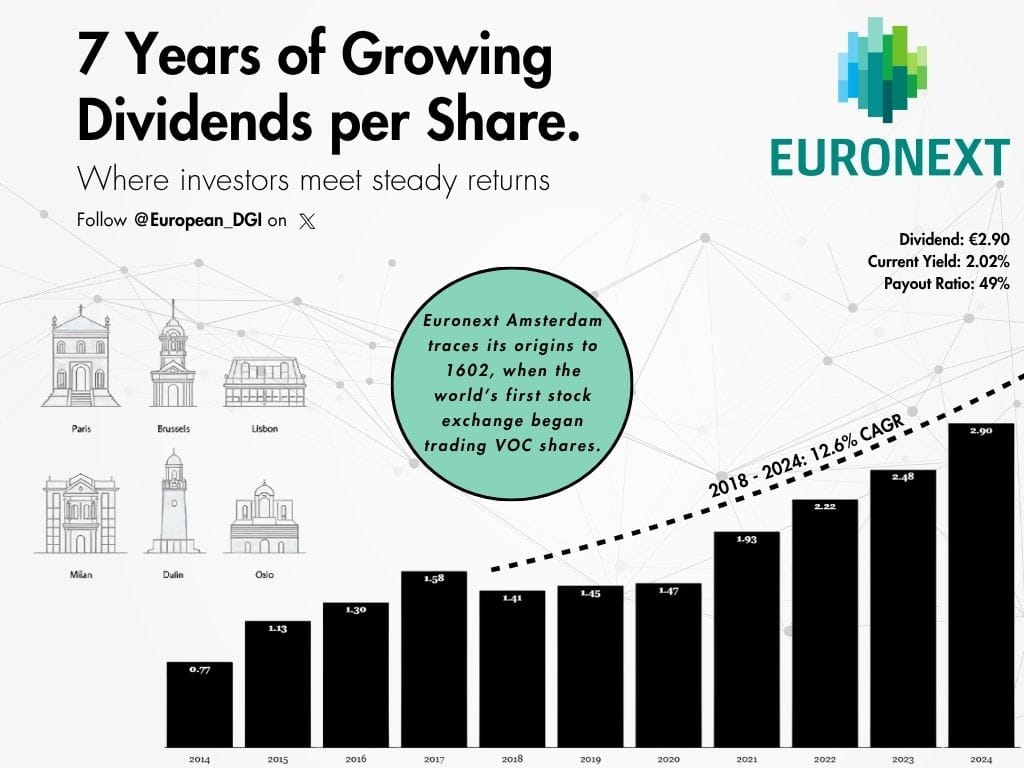
Given this, the company paid €2.90 in dividends for 2024, which translates into a dividend yield of 2.04% at the time of writing, or 1.74% after withholding tax.
Dividend Policy
One thing I find slightly frustrating is that they recently clarified their capital allocation strategy for 2027, committing to a 50% dividend payout ratio, with the possibility of special dividends if the balance sheet permits.

Source: 2027 strategic plan
This annoys me because I believe the company has the potential to become a true European dividend aristocrat one day. I see no reason why they couldn’t adopt a progressive dividend policy to better reward and encourage long-term ownership.

However, I do appreciate that the dividend ranks as their third priority, after organic business growth and maintaining a healthy balance sheet.
Additionally, I like their focus on ROIC when acquiring new businesses, aiming for returns that exceed the cost of capital within 3 to 5 years. To me, that’s a textbook example of smart hockey-stick investing.
Dividend History
So far, the company has paid dividends annually, usually around the end of May, maintaining a 50% dividend payout policy since its IPO in 2014.

While the dividend has grown significantly at a 13.2% CAGR, rising from €0.84 to €2.90 today, including the latest 17% increase, it did experience several cuts between 2017 and 2020.
This clearly illustrates the dividend policy in action, reflecting the volatility of earnings per share during that period. It’s unfortunate because it makes the dividend less reliable, being quite sensitive to the economic cycle and the company’s ability to grow its underlying earnings each year. Since 2020, this hasn’t been an issue, but a future recession could still trigger a moderate dividend cut.
Perhaps this is why the company wants to focus more on growing non-volume related earnings before committing to a progressive dividend policy?
Can they afford their dividend?
At this moment, it’s a no-brainer. They have a strong balance sheet, with €1.6 billion in cash, while the total annual dividend payment is only €260 million.
On top of that, their earnings continue to grow in the high teens as per their latest earnings report, so I see no reason why the company couldn’t afford a steadily growing dividend.
Dividend Safety Conclusion
Generally speaking, the dividend isn’t entirely safe due to the 50% payout policy and the company’s history of occasional earnings declines.
That said, there are many tailwinds driving the business forward, both in terms of revenue and underlying earnings. They also have a strong balance sheet, healthy payout ratios, and promising future prospects.
For these reasons, I would rate the dividend as borderline safe, assigning it a dividend safety score of 60. It’s a shame, because adopting a progressive dividend policy going forward could make the dividend much safer, potentially pushing the score above 80.
In this case, I would argue that the company has potential for continued double-digit annual dividend growth, but with occasional dividend cuts depending on earnings fluctuations. Growth simply doesn’t follow a straight line when it comes to Euronext.
Valuation
I’m very curious to what the conclusion will be in terms of its valuation, because the company really intrigues me and probably even more so than London Stock Exchange Group.
Let’s have a look into it.
Valuation Multiples
I always like to do the simple litmus-test first by looking at the price to earnings and price to free cash flow multiples.
- p/e: 25.2
- p/fcf: 21.3
According to these numbers, the company seems to be slightly overvalued, also if we consider the PEG ratio which comes out slightly above 2.0.
| The PEG ratio measures a stock’s price relative to its earnings growth, calculated by dividing the price-to-earnings (P/E) ratio by the expected annual earnings growth rate; a PEG below 1 typically suggests the stock is undervalued, while a PEG above 1 may indicate overvaluation. |
Dividend Discount Model (DDM)
The dividend discount model assumes that dividends are the only return we’ll ever receive from investing in Euronext. I like this model because it aligns with our investment philosophy: the intent is to buy and hold, not to sell.
Assuming an 11% discount rate and a high-single-digit dividend growth rate of 9% over the next five years, the fair value comes out at €145 per share. This suggests the company is fairly valued at the moment.
| Ticker | EPA:ENX |
| Dividend per share | 2.90 |
| Discount rate | 11.00% |
| Dividend growth rate | 9.0% |
| FAIR VALUE | 145.00 |
The 9% dividend CAGR is based on recent high-teen percentage growth rates, balanced with the company’s own growth expectations as outlined in their 2027 strategic plan.

Discounted Cash Flow Model
Looking at it from a free cash flow point of view, I’m using the average over the last four years (since the acquisition of Borsa Italiana), which amounts to a conservative €645 million in annual free cash flow.
As with the dividend discount model, I’m assuming an 11% discount rate and a 9% growth rate for the first five years, followed by 5% thereafter. I’m also assuming an 18x terminal multiple, which I believe is fair for a strongly growing company with ample opportunity to expand further in the fragmented European market.

Source: DCF and DDM gSheet
Taking all of this into consideration gives us a fair value estimate of €131.08 per share in our baseline case. In a more pessimistic scenario, such as prolonged economic stagnation, the valuation could drop to around €85. On the other hand, if growth exceeds expectations, the valuation could reach up to €158. While we view both of these scenarios as unlikely at this point, they help illustrate the potential valuation range.
Valuation conclusion
To conclude, we’ve assessed Euronext’s potential fair value from three different perspectives, and based on this, I believe the company is fairly valued at approximately €130 per share.
Applying a 10% margin above and below this figure gives us a fair value range, which suggests that the company is currently trading at a fair price.
Top 3 Risks
While I’m quite bullish on the future of Euronext, it stays important to also look at it from a “what-may-go-wrong” point of view to solidify the investment thesis.
With that in mind, let’s have a look at the top 3 risks that could impact its future earnings in a negative way.
1️⃣ Competitive Pressures: Euronext faces fierce competition in all industries. This ranges from data providers like Bloomberg and LSEG to startups and other listing companies. There is also strong pressure on pricing and market share in cash equities trading and derivatives trading (especially equity options) which may lead to a loss in market share for Euronext.
Likelihood in the next 5 years: Medium | Impact: High
2️⃣ Regulatory and Compliance: the company is very exposed to regulatory oversight in the multiple countries that it operates in. Governments are unpredictable, especially in the political climate we’ve experienced over the last few years. Furthermore, Regulatory changes (e.g., MiFID II/MiFIR, EMIR, CSDR, etc.) can significantly impact Euronext’s operating and compliance costs, and may affect its competitive position and revenue streams.
Likelihood in the next 5 years: Medium | Impact: Medium
3️⃣ Technology and Cybersecurity: Technology is a key component of Euronext’s business strategy, and its success is crucially dependent on the security, performance, and stability of its complex computer and communication systems. A major security breach could lead to interruptions in the operations of the stock exchanges it operates or for instance painful data breaches.
Likelihood in the next 5 years: Medium | Impact: High
Final Thoughts
If you asked me to briefly explain why I bought Euronext as a position in my dividend growth portfolio, it would be the following:
Euronext appears to be a great business with strong tailwinds at the moment. It has solid organic growth opportunities through further consolidation and vertical integration of its business model, combined with the potential for mergers and acquisitions, as the European market remains relatively fragmented.
Looking at it from another angle, compared to the US, Europe’s capital markets still feel less mature from a retail investor’s perspective. This leaves room for Euronext to catch up over the next decade, especially if the EU succeeds in implementing its plans to further integrate European capital markets.
That said, there is one major caveat: management’s commitment to the dividend. There’s no indication that they would maintain or grow the dividend if earnings were to decline and its history proves differently. That’s why I wouldn’t classify Euronext as a dividend growth stock, but rather as a dividend-paying stock with strong long-term growth potential.
We hope you found this deep dive insightful. Feel free to reach out if you have further questions, there’s much more information available than we could reasonably include in this article.
Yours Truly,
eDGI & Derek
Disclosure of ownership at time of writing:
- European Dividend Growth Investor has no shares in Euronext
- Derek owns no shares in Euronext